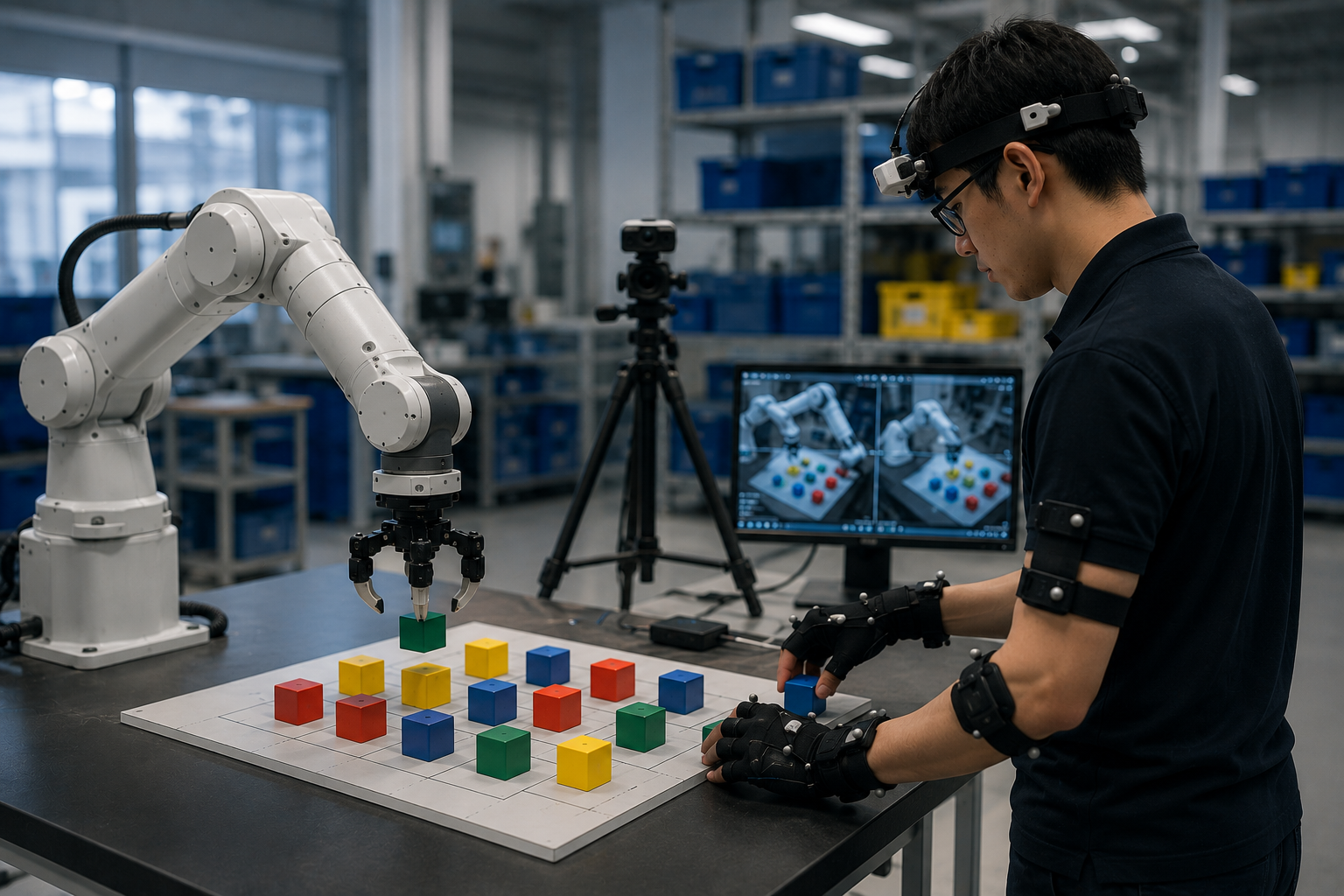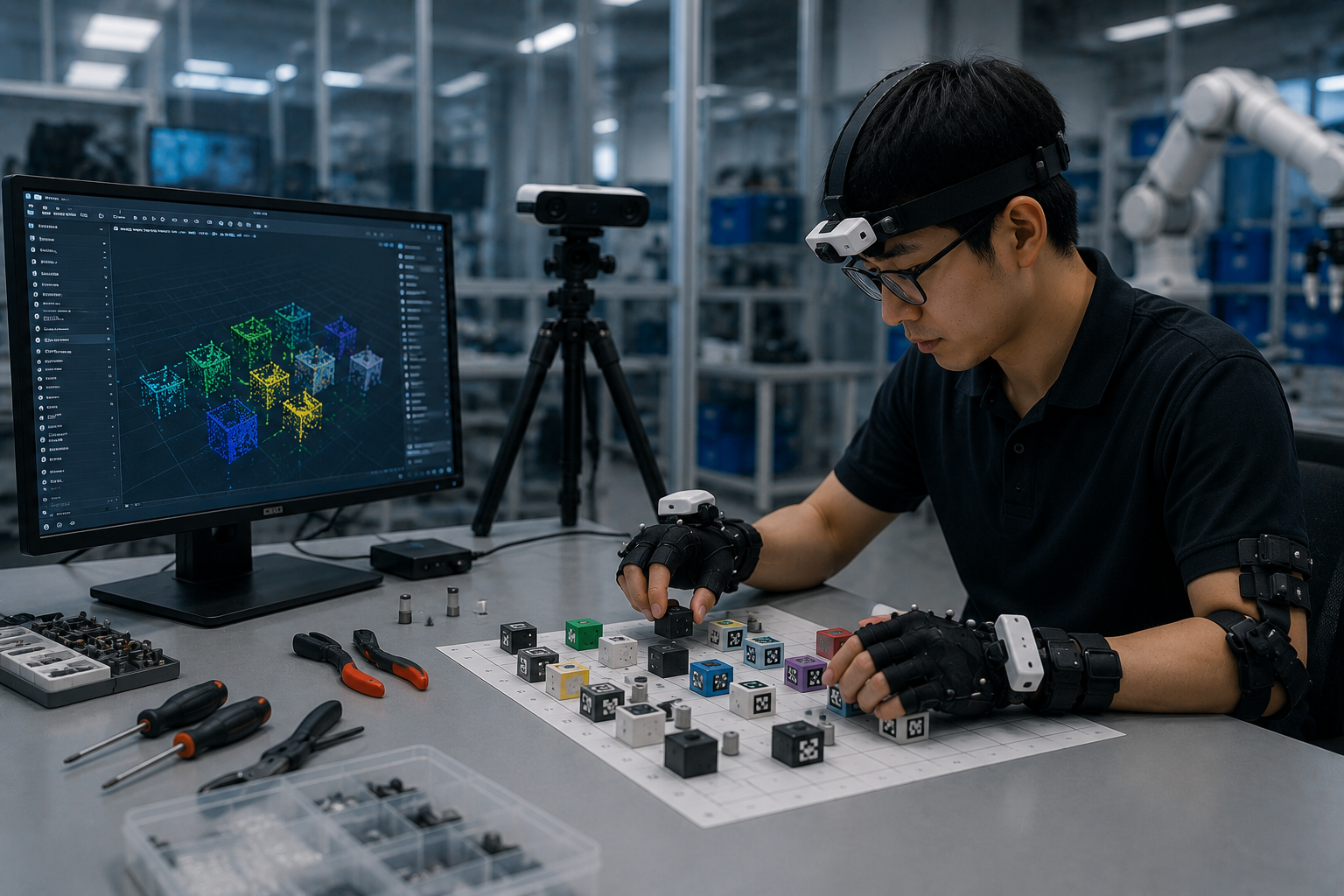
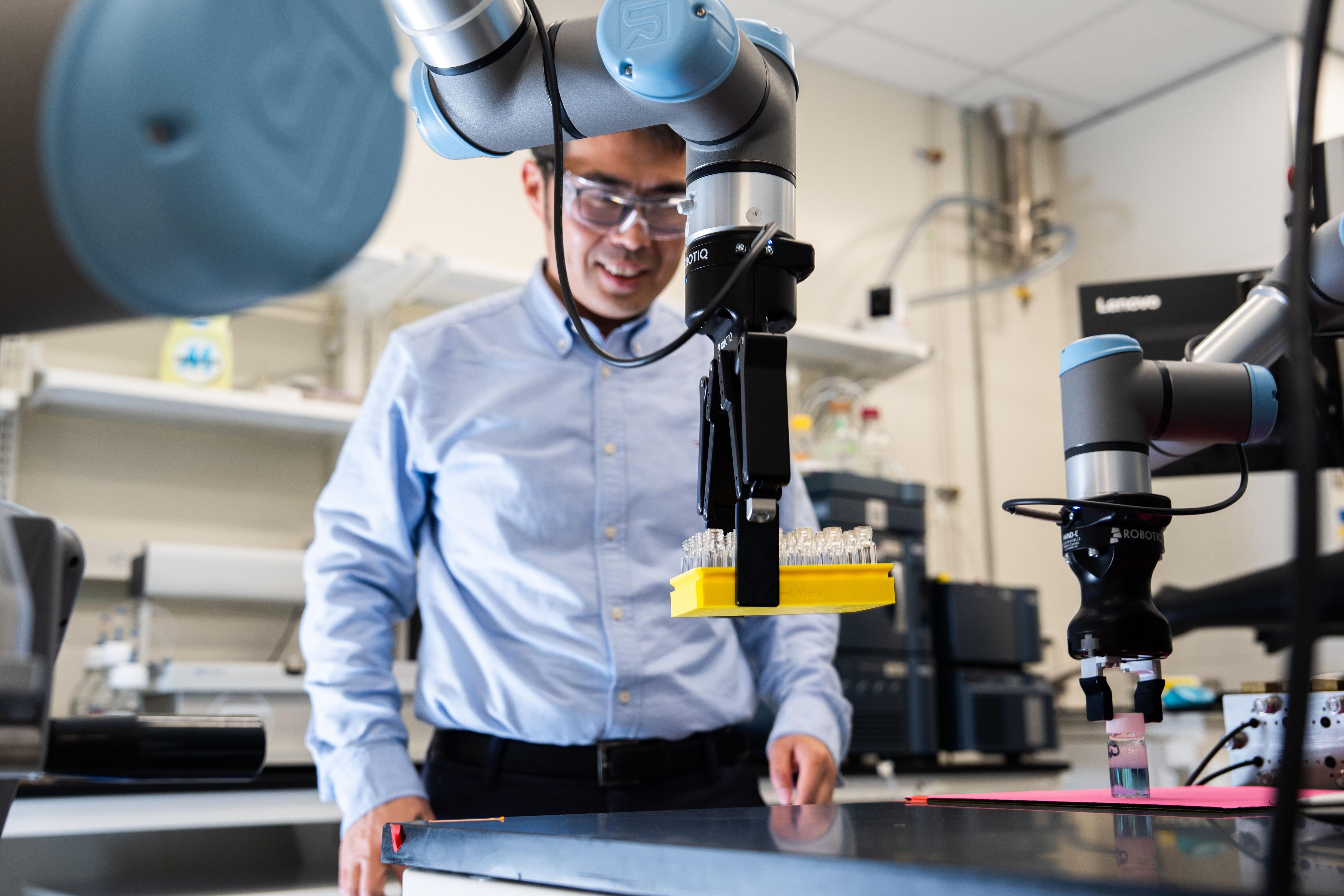

When we watch a robotic arm pick up a product from a table and place it into a box, all we see is an action that takes just a few seconds.
But within those few seconds, a continuous chain of processing is taking place between cameras, sensors, AI, and the robot control system.
A simple way to think about it is to compare it with how humans work: eyes perceive – brain processes – body acts.
1. Perception – Helping the Robot “See”
First, the robot needs to understand what is around it.
This process is commonly called Perception—simply put, the ability to perceive and understand the surrounding environment.
An RGB camera captures images much like a regular camera.
For some tasks, systems also use a Depth Camera—a camera capable of measuring distance. This means the system can not only recognize “this is a box,” but also determine how far the box is from the camera.
Depending on the task, a system may also use LiDAR, force sensors, encoders, or other types of sensors.
Data from multiple sensors can also be combined to create a more complete understanding of the environment. This technique is commonly known as Sensor Fusion.
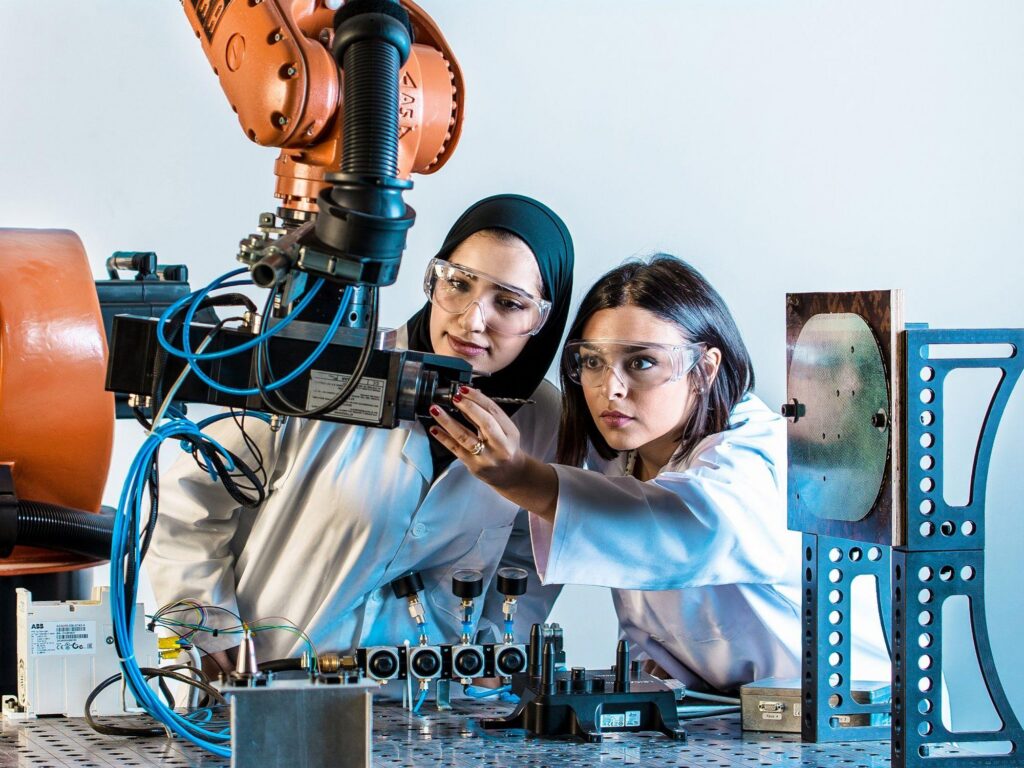
Camera → RGB Image + Depth → Object Detection → 3D Position
2. AI Turns Images Into Information the Robot Can Use
A camera only produces data.
AI is what helps the system understand that data.
For example, suppose the camera sees a cup. A computer vision model may determine:
Object: Cup
Position: (x, y, z)
Orientation: Direction of the cup
Confidence: How confident the model is in its recognition result
The three values x, y, z can simply be understood as the object’s coordinates in three-dimensional space.
At this point, the robot is no longer just looking at an image.
It now has something much more useful:
“There is a cup at this position.”
3. Planning – The Robot Has to Figure Out What to Do
Knowing where the cup is still isn’t enough.
The robot must calculate how to move its arm toward the cup without hitting the table or other objects around it.
This is known as Motion Planning.
The system may need to answer a sequence of questions:
Where is the robot now? → Where is the target? → Are there any obstacles? → What trajectory should it follow?
Once a trajectory has been calculated, the control system sends commands to the motors at each joint of the robot.
Camera/Sensor → Perception → AI Model → Planning → Robot Controller → Motor / Robot Arm
This is a simplified version of a Physical AI pipeline.
4. But Where Does the Robot Get These Capabilities?
This is where things become more difficult.
We cannot manually program every possible situation:
“If the cup is on the left, do A.”
“If the cup is rotated 30 degrees, do B.”
“If there is a box blocking the way, do C.”
The real world contains far too many variables.
That is why an important direction in modern robotics is to enable robots to learn from data and experience, rather than programming a separate rule for every possible situation.
This data can come from cameras, sensors, real robots, human-operated robots, or simulated environments. Modern robotics workflows may also combine demonstration collection, policy training, evaluation in simulation, and finally deployment on real robots.
This is also why collecting data for Physical AI is not simply about “recording as much video as possible.”
The video needs to be connected to actions.
What does the camera see? What state is the robot in? How is the arm moving? Is the gripper—the part used to grasp objects—open or closed?
When all of this information is synchronized over time, we begin to have a dataset that a robot can actually learn from.
And that leads to an even more interesting question:
How does a robot actually learn from this data?
That is where Imitation Learning, Vision-Language-Action (VLA) models, Simulation, and Sim-to-Real come into the story.